Top Beauty Therapist: "The Facial-Hair-Removal Industry Has Been Lying to Women Over 40 — And This 30-Second Ritual Changes Everything"
A veteran beauty therapist teams up with a consultant dermatologist to expose the cycle keeping millions of women tweezing in the car mirror every morning — and the water-based serum that finally slows the regrowth at the root. No laser. No waxing. No needles.
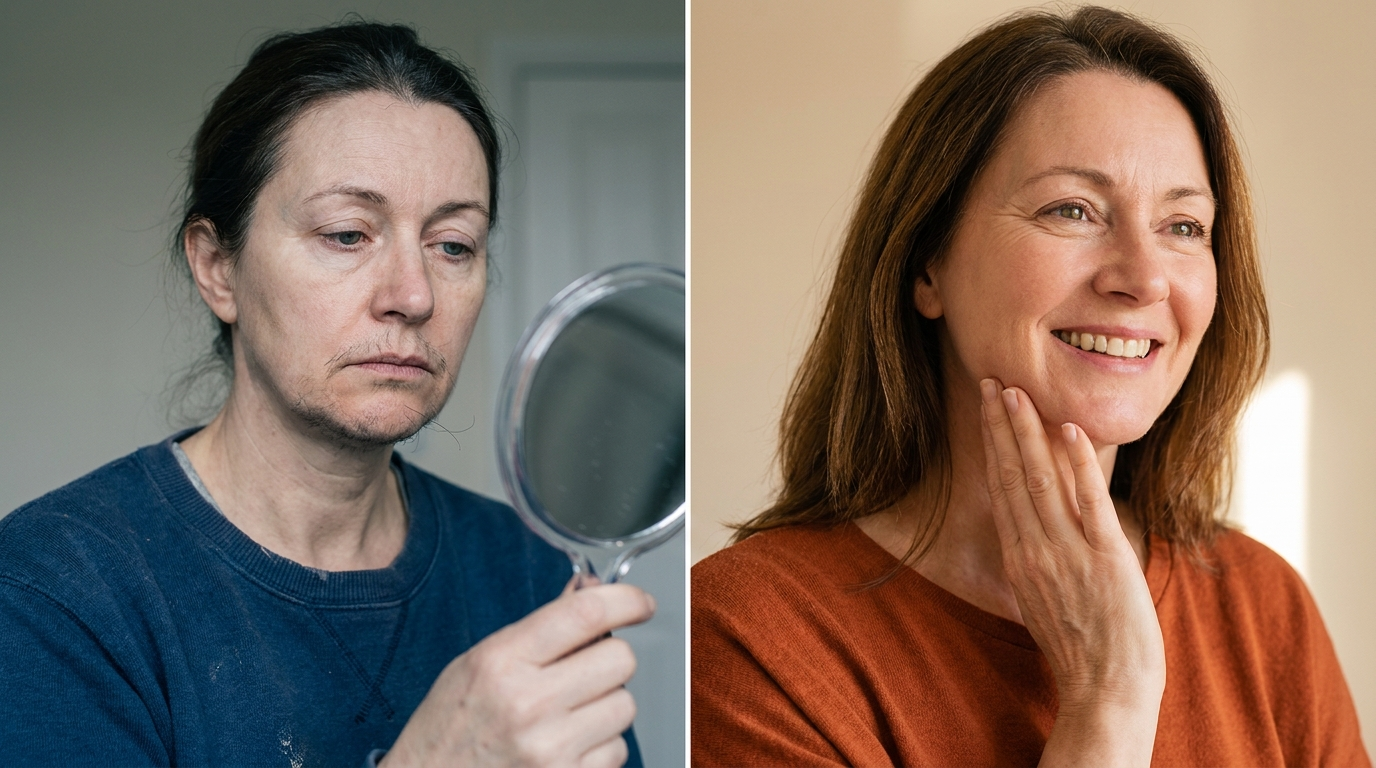


I'm about to make every waxing salon, laser clinic and electrolysis studio in the country very uncomfortable.
My name is Emma Whitfield. I've been a beauty therapist for 22 years.
I've removed more chin hair, upper-lip hair and jawline stubble than I could ever count. I know exactly what coarse, hormonal facial hair feels like under my fingers. And over the past five years, I've felt something that still makes my stomach turn.
The women in my chair weren't getting better. They were getting worse. Coming back sooner. Stubble thicker. Hairs darker. More of them. And every one of them believed the same thing — that it was just her hormones, just her age, just her cross to bear.
I'm about to tell you something the facial-hair-removal industry does not want you to hear. Because I finally understand why the hair kept coming back stronger — and it isn't your hormones. It's the one thing almost every woman does to get rid of it.
If you're reading this while touching your chin for the hair you know is there… the next 10 minutes could change everything.
The Day Susan Sobbed In My Chair

It was a Tuesday afternoon. Susan sat down for what should have been a routine chin and lip wax. She was 54. A primary-school teacher. Married 28 years. The kind of woman who lights up a room.
Except she wasn't lighting up anything that day.
I'd been waxing Susan for six years, and I'd watched it change — slowly at first, then faster. Every visit, a little coarser. A little darker. That afternoon she looked in the mirror, saw the shadow already coming back on a chin I'd waxed twenty minutes earlier, and just… broke.
Not crying. Sobbing.
She told me she now keeps tweezers in the car, because a red light is the only daylight bright enough to catch them. That some mornings a hair was "literally one day not there, and the next day an inch-long pipe cleaner poking out." That she'd started avoiding photographs entirely.
That's when something inside me snapped. Because I realised I'd been part of the problem. For six years I hadn't been treating Susan's facial hair. I'd been feeding it. So I made her a promise: give me some time — I'm going to find out what's actually happening to your skin.
What I Found When I Stopped Removing And Started Reading

For three months I became obsessed. I pulled every product off my shelf — every "inhibitor," every serum I'd resold for years — and read the labels properly. Most were 95% water and fillers with a trace of something "active." Just enough to print on the box. Not enough to do a thing.
Then I hit the pattern that made me feel sick. The women who'd waxed and plucked the longest had the most hair. One client put it perfectly: "I plucked my chin for 25 years and ended up with WAY more hairs than I started with."
That wasn't a coincidence. That was a cause. One name kept coming up in the research — a consultant who'd been saying the same thing from the clinical side for years. I sent her a cold email. She replied within 24 hours: "You're the first therapist who's ever asked me this. Everyone in your industry sells removal. Nobody asks why it stops working. We need to talk."
Why Removing It Is Making It Worse

Dr. Sarah Mitchell, Consultant Dermatologist:
After 14 years treating women through perimenopause and beyond, here's what the industry would rather you didn't know: your regular waxing, plucking and threading are very likely making your facial hair worse.
Every time you rip a hair out at the root, you traumatise the follicle. Do that over and over — week after week, year after year — and the body reads the repeated injury as a threat, and protects itself the only way it knows how.
It builds a thicker, stronger, darker hair.
This is called follicular hyperactivity. The more you remove, the harder the follicle fights back. The cycle funds itself — and an industry that sells you the removal has no reason on earth to tell you. Here's what nobody explains before they take your money:

Laser only works for some women
- Works best on dark hair, light skin only
- Barely touches grey, white, red or blonde — "it doesn't get the white hairs"
- Hormonal hair often regrows within 1–2 years

Electrolysis is even more impractical
- Hundreds of tiny needles, hundreds of sessions
- Painful, slow, can leave tiny scars
- Not actually permanent for everyone
The Real Cost Of "Trying Everything"
Thousands of pounds, years of your mornings — and you're still hunting for whiskers in every shop window. Because none of it addressed the cause. And if you've been to the GP, you were probably told it's "just cosmetic." You were fobbed off. This isn't your fault — you were never given the real answer.
Your Follicle Is A Tiny Factory. Turn Down Its Power.
Dr. Mitchell: Think of each follicle as a tiny factory. To build a thick hair it needs enormous amounts of power — a molecule called ATP, the energy currency of every cell.
Waxing and laser try to shut the factory down or destroy it — which is exactly what makes it fight back harder. But what if you didn't attack the follicle at all, and simply turned down its power supply so it couldn't keep producing coarse hair?
ATP = the follicle's power
Follicle cells need a lot of ATP to divide fast enough to grow thick hair.
Cyperus Rotundus = a gentle signal
An ancient Egyptian botanical that interferes with ATP production in the follicle — it doesn't burn, cut or destroy anything.
Less energy = slower, finer, lighter growth
With less power the follicle can't build the same coarse hair. Regrowth comes back slower, thinner and lighter — a measured 84% reduction in growth rate with continued use.
Critically, it works locally — on the exact patch of skin where you apply it. It does not enter the bloodstream and it does not touch your hormones.
Not An Oil. A Water-Based Serum That Actually Absorbs.

Emma: Dr. Mitchell had the science. I knew what women would actually use — I'd watched clients abandon messy oils and 6-step routines for 22 years. So we built the opposite. A light, water-based serum that absorbs down to the follicle instead of sitting greasy on top. No residue. No smell that announces to a room what you're treating. You spray it, rub it in, get on with your morning. About 30 seconds, twice a day. That's the whole ritual.
We Tried It On Ourselves First

Neither of us is immune to this. So we became our own guinea pigs — and tracked it honestly. This is the timeline we tell every woman to expect, because we won't overpromise:
- Week 1: usually nothing. This is where most women quit — don't. It works in stages.
- Week 2: stubble comes back softer, less prickly. The "barbed-wire" feeling fades.
- Week 4: visibly finer and lighter. Dark shadow fading. Ingrowns calming.
- Month 3: smooth, with only the occasional fine hair. The gap between removals stretches right out.
Women Who'd Given Up Hope

"I used to pluck every single morning, sometimes twice a day before I'd even leave the house. Three weeks in and there's barely anything there. I'd honestly given up hope."
"I spent over £1,000 on laser and it never touched the white hairs — 'it doesn't get the white hairs,' they finally admitted. This is the first thing that's worked on mine."
"I could feel what seemed like barbed wire on my chin and had to pull a few out most days. Now I run my hand over it and it's smooth. My husband hasn't felt a single one."
"The hair on my head was going whiter while my chin hair went darker. It felt like a cruel joke. Eight weeks in the regrowth is finer and lighter and I've stopped flinching at mirrors."
"I kept tweezers in the car for traffic-light plucking. That was my life. I felt mortified. I don't do that anymore — I forgot what a gloriously smooth chin even felt like."
What We Actually Measured
Figures reflect our own user observations and lab-measured growth rate; individual results and timelines vary.
They Didn't Like Us Saying This Out Loud
The moment I started telling clients the truth — that the products on my shelf weren't fixing the problem, they never had — the "friendly warnings" started. A supplier told me I was "hurting the professional hair-removal industry" by recommending something women could use at home. Two reps stopped returning my calls. A laser clinic I'd referred to for years told a mutual client I'd "gone off the deep end."
Translation: you're cutting into our revenue and we don't like it. Of course they don't. Every woman who slows her regrowth at home is a chair they no longer fill every three weeks. Forever. That's exactly why we're telling you anyway.
Velura Viareline Skin Serum Pro

The only water-based facial-hair serum built around all three things that actually change regrowth — not just cover it up.
Break the hyperactivity cycle
Soothes the follicle so it stops overcompensating with coarser, darker hair after every removal.
Cyperus Rotundus at the root
Gently interferes with the follicle's ATP energy so it can't build the same thick hair — slower, finer, lighter over time.
HA + ceramides
Clears ingrowns and bumps, calms redness and hydrates mature skin so the area looks better, not just less hairy.
What's Really In The Bottle

- Cyperus Rotundus Extract — a meaningful dose targeting follicle ATP, not a homeopathic trace for the label.
- Hyaluronic Acid — deep hydration for the mature skin most methods leave raw.
- Ceramides — rebuild the barrier, calm redness, help clear ingrowns.
- Water-based, not oil — so it absorbs to the follicle instead of sitting greasy on top.
- No hormones, no harsh acids, no "proprietary black box." Acts locally; never enters the bloodstream.
Our "Screw You" To The Removal Treadmill
This category has a trust problem — hidden subscriptions, charges under different names, refunds that never come. So here's exactly how we do it, in plain English:
- One-time purchase. No subscription, no auto-billing, no small print.
- Nothing to cancel. You buy a bottle, that's it.
- Real 60-day money-back guarantee. Use it for two months. If your regrowth isn't slower, finer and lighter, email us and get your money back.
DAY
You risk nothing. Give the follicle two months to respond. If you're not seeing softer, finer, lighter regrowth, we refund you — keep the bottle. The only thing you lose is the tweezers in your car.
Beauty therapist with 22 years behind the chair, specialising in facial-hair treatment for women over 40.
Consultant dermatologist, 14 years treating women through perimenopause, PCOS and hormonal skin change.